Engineering Africa’s Future with Indigenous Wisdom and Artificial Intelligence
Africa does not suffer from a shortage of engineering knowledge; it suffers from a shortage of recorded engineering knowledge— held instead in apprenticeship, oral formula, and the muscle memory of master craftsmen, and now disappearing as elder practitioners die and formal schooling in colonial languages breaks the chain of transmission.
For centuries the continent sustained sophisticated technical traditions — natural-draught bloomery furnaces that produced carburised steel in present-day Tanzania and Zimbabwe, hydraulic terracing in Ethiopia, dry-stone construction at Great Zimbabwe, seasonal forecasting read from insect and plant phenology, and rotating credit institutions that priced risk without a balance sheet.
Across the Sahel, mud-brick homes rise into perfect vaulted roofs without a single piece of timber or steel — a technique refined over centuries and known today as the Nubian Vault. In the highlands and drylands of the continent, farmers have long read sky, soil, and insect behaviour to forecast rain with an accuracy formal meteorology sometimes envies. The argument of this article is narrow and practical: African Indigenous Knowledge Systems (AIKS) should be treated not as heritage to be preserved but as engineering data to be operationalised — and artificial intelligence is what now makes that operationalisation possible.
Capture, Structure, Validate, Deploy
A credible AIKS-to-AI programme moves through four stages. Capture uses automatic speech recognition tuned for African languages to record elders and artisans in their own tongue — the Masakhane collective has already built open translation and ASR models for more than forty African languages through participatory research Structure turns raw transcripts into machine-readable rules: large language models convert oral testimony into ontologies of condition, action, and outcome, so that “when the mopane worms appear early, plant short-season sorghum” becomes a testable rule rather than a proverb. Validate is the stage that matters most — each extracted rule is tested against instrumented sensor data, and AIKS earns its place in an engineering function through predictive performance, not cultural deference; hydrological models trained on indigenous water-harvesting designs, for instance, often confirm that the older method is the more climate-resilient one. What survives validation moves to Deploy: embedded in decision-support tools, hybrid models, and control logic alongside conventional physics.
Ten Proofs Already at Work
Sceptics who dismiss this as academic romance need only look at ten case studies already reshaping construction, machining, metallurgy, mining, agriculture, energy, finance, and mobility across the continent.
The Eastgate Centre, Harare
When architect Mick Pearce needed to cool Harare’s Eastgate Centre without conventional air conditioning, he turned to the termite mound — an indigenous engineering marvel that holds internal temperature steady despite scorching swings outside. His team translated the mound’s chimney-and-flue airflow into forty-eight brick funnels that draw cool air upward and vent hot air out the top. The building now runs on roughly a tenth of the energy a conventionally cooled equivalent would need, saving its owners millions of dollars by skipping a chiller plant entirely — the same thermal logic that has long shaped vernacular African walls, courtyards, and thatch ventilation for passive comfort. Generative design tools trained on catalogued vernacular typologies can now reproduce that logic automatically, at a fraction of the cooling load, for new climates and building forms.
Hardwood as Bearings, Reinvented
Long before tribology had a name, artisans knew that certain oil-rich hardwoods run smoother, cooler, and longer than metal. Lignum vitae — dense, self-lubricating, and water-resistant — has carried ship propeller shafts and hydroelectric turbine bearings since the 1920s, and even supports the shaft of the USS Nautilus, the first nuclear submarine, after decades without maintenance. African hardwoods used for generations in traditional grinding mills and water-lifting gear rest on the same empirical insight. Materials-informatics AI can now screen thousands of such species computationally, matching natural oil and grain properties to modern bearing and bushing applications far faster than laboratory trial and error.
Jua Kali and the Sound of a Bearing
Across East Africa, jua kali — informal roadside workshops, literally “fierce sun” — sustain a vast repository of repair, reverse-engineering, and improvisation knowledge that formal engineering training never teaches. A jua kali mechanic diagnosing a failing bearing by its sound, or a weld by its colour, is reading exactly the tacit signals that acoustic and thermal condition-monitoring systems are trained to detect — the elder’s ear and the vibration sensor are solving the same problem. Capturing this expertise through video and multimodal AI models is now producing searchable maintenance and fabrication knowledge bases, turning decades of craft intuition into a training set a formally trained analyst can learn from in months.
Meroë’s Iron Mountains
Thirteen centuries before a comparable furnace tradition further south, smelters at Meroë in what is now Sudan were already running industrial-scale ironworks. From roughly the 8th century BCE to the 4th century CE, the city’s furnaces at Meroë and neighbouring Hamadab consumed vast quantities of charcoal and ore, leaving behind slag heaps so extensive that early archaeologists nicknamed Meroë “the Birmingham of Africa” — after Britain’s own iron-forging capital. That iron moved along the same caravan and river routes as gold, ebony, and ivory into Mediterranean and Red Sea trade networks. The same instinct for reading ore from its surroundings survives today in artisanal prospectors, who locate deposits from vegetation, termite-mound composition, and stream sediment; those heuristics now serve as training labels for computer-vision models that screen satellite imagery for exploration targets, cutting drilling costs without displacing the prospectors who supplied the knowledge.
Mineral Processing: The Haya Furnace
Two thousand years ago, Haya smelters in what is now north-western Tanzania built shaft furnaces lined with termite-mound clay and fed by preheated air from goatskin bellows, reaching internal temperatures above 1,500°C — hot enough to skip the low-grade bloomery iron that dominated the rest of the world for centuries and produce carbon steel directly, using nothing but charcoal, ore, and airflow control. It is indigenous mineral processing and extractive metallurgy at a level European furnaces would not match for another eight hundred years, one example of a wider African tradition of natural-draught bloomery furnaces achieving consistent low-carbon steel through tuyere geometry, charcoal selection, and process control encoded as ritual timing. Archaeometallurgists now run computational fluid dynamics on surviving furnace geometries to reverse-engineer how the Haya did it — insight feeding today’s search for low-carbon “green steel” and for small-scale, decentralised units suited to distributed charcoal and biomass reductants.
Lake Katwe’s Salt Gardens
In the crater of an extinct volcano in western Uganda, Lake Katwe has supplied salt through pure solar engineering for centuries: brine is channelled into shallow evaporation pans, and as water leaves by evaporation alone, crystallised salt is left behind for harvest. The work follows the seasons — evaporation pans run hardest in the January–March and July–September dry spells — and follows a deliberate division of labour, with women raking crystallised surface salt and men diving for denser salt blocks that settle on the pan floor. Computer vision now performs comparable sorting tasks at industrial throughput in mineral beneficiation more broadly, with indigenous sorting criteria — colour, lustre, density — supplying the feature set and the labelled training data.
ITIKI: When Insects Forecast the Rain
In rural Kenya and South Africa, the ITIKI system fused indigenous drought indicators — bird migration, tree flowering, insect and wind behaviour — with wireless sensor data and machine learning, and the result outperformed conventional forecasting models at the village scale. Farmers trusted it precisely because it spoke a familiar idiom rather than a meteorologist’s. The same architecture now extends to intercropping optimisation, indigenous pest control, and soil-fertility management, all grounded in agroecological practice developed long before the term existed.
Biogas: Ancient Decomposition, Modern Grids
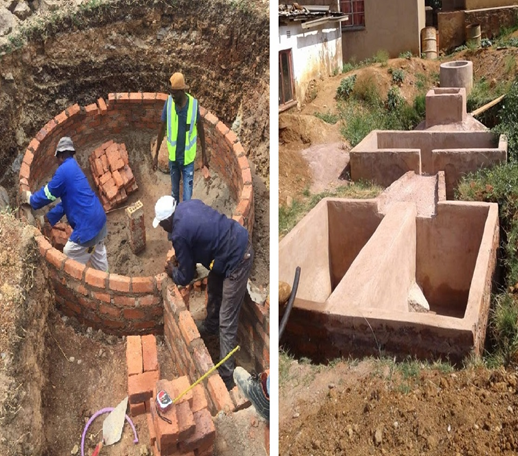
Communities across the continent have long known that penned livestock waste, left to decompose, yields heat, gas, and rich fertiliser — an intuition now engineered into household biodigesters supplying clean cooking energy to rural farms in South Africa, Kenya, and Rwanda [16]. Where early digesters were sized by guesswork, AI models now predict gas yield from feedstock mix, ambient temperature, and retention time, letting technicians site and size systems correctly the first time — the same siting logic now being extended to micro-hydro placement on seasonal streams and to mini-grid load forecasting driven by indigenous demand patterns such as milling and pumping seasonality.
Esusu: An Indigenous Trade Mechanism, Digitised
Long before formal banks reached most African communities, rotating savings and credit associations — known as susu in Ghana, esusu among the Yoruba, and by other names across the continent and its diaspora — let members pool fixed contributions on a schedule and take turns receiving the full pot, a trust-based financing mechanism that priced risk without a balance sheet. The American fintech company Esusu, founded in 2015 by Nigerian-born Abbey Wemimo and Samir Goel, digitised the same rotating-contribution logic into an app, then extended it: it reports members’ on-time payments to the major credit bureaus, letting people with no US credit history build one. The pattern generalises further — graph neural networks trained on mobile-money and community-network data can now turn indigenous trust metrics like kinship guarantee networks into credit-scoring features, extending formal finance to the majority who have never held a conventional credit history.
From Zimbabwe’s Shared Taxis to a Billion-Dollar App
In 2006, a young American named Logan Green visited Zimbabwe and noticed the streets were quiet — not from poverty, but because locals filled shared minivans through an informal carpool network more efficient than anything on his own college campus. He named his ride-matching platform Zimride in tribute; it launched at Cornell in 2007 and, by 2012, had become Lyft. Rural Africa still runs substantially on informal networks like it — seasonal fording points, footpaths, and market-day flows invisible to commercial mapping — and community mapping paired with computer vision on satellite imagery is now reconstructing them, letting route-planning algorithms work from how people actually move rather than from the trunk-road assumptions inherited from colonial-era planning.
Guardrails
None of this is automatically benign, and three risks deserve deliberate management. The first is extraction — communities supply knowledge and receive nothing back; the CARE Principles for Indigenous Data Governance and indigenous data-sovereignty frameworks should govern every AIKS dataset. The second is romanticisation: not all traditional practice is efficient or safe — mercury amalgamation in artisanal gold mining is proof enough — and validation must be genuinely capable of rejecting what does not work. The third is dependency: models trained on African knowledge should be hosted, owned, and governed on the continent, or the pipeline simply reproduces the extractive pattern it claims to correct . South Africa’s draft National AI Policy has already flagged indigenous-knowledge protection as a governance priority — a sign that regulation is beginning to catch up with both the opportunity and the risk.
A Task for the Engineering Fraternity
None of this happens by accident. Engineering councils, universities, and professional bodies must treat AIKS as legitimate engineering data, not a footnote — funding capture and validation led by, not merely about, the communities that hold the knowledge; embedding validated techniques into curricula, codes, and financial infrastructure; and building the capture-structure-validate-deploy pipeline as African-owned infrastructure rather than another externally hosted dataset. Eastgate, jua kali, Meroë, the Haya furnace, Lake Katwe, ITIKI, biogas, Esusu, and Lyft prove the pattern already pays off — commercially, environmentally, and socially. Indigenous knowledge was never primitive engineering; it is centuries of empirical optimisation against local constraints that have not disappeared. With AI as translator, validator, and amplifier, it can finally take its rightful place at the drafting table.


Leave a Reply