One Plant, One Team, Part Three: Why Good Starts Fade, and How to Stop It
In Run It, Fix It, Own It Together we made the case for treating the plant as one connected system. In From Slogan to Shift we set out the routines that make it real: start with a bad actor, clean and tag together, hold joint handovers, close the loop on every failure and keep one shared scoreboard. That article ended with a short warning list. This one opens that list up, because the traps decide whether the routines survive their first bad month.
Programmes Don’t Collapse. They Fade.
Nobody stands up in a production meeting and announces that shared ownership is cancelled. The posters stay on the wall and the board stays in the control room. What changes is quieter. The joint handover drifts back to two separate ones. Basic care checksheets get ticked at the end of the shift by someone who never touched the machine. The red tags fade in the sun.
By the time anyone notices, the old line between “I run it” and “you fix it” is back, and now it comes with cynicism: we tried that, it didn’t work. The second attempt is always harder than the first.
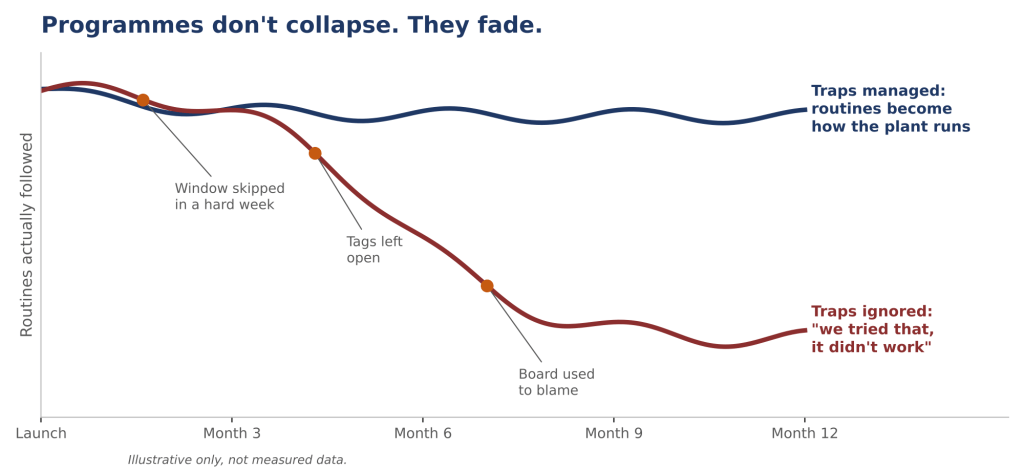
The traps below are the usual reasons. None of them is dramatic, and every one of them is avoidable if you know what to look for. For each trap: what it looks like on the plant floor, why it happens, and what to do instead.
Seven Traps That Kill Shared Ownership
1. Handing Over Tasks Without Handing Over Capability
What it looks like: Operators are told they now own lubrication and inspection on the pilot asset. Nobody shows them the grease points, there is no grease gun at the station, and the shift plan still runs them flat out on tonnes. Within weeks the checksheet is signed but the work is not done.
Why it happens: Basic care gets treated as a way to move work off the maintenance backlog. Operators read it the same way: extra work, no extra support.
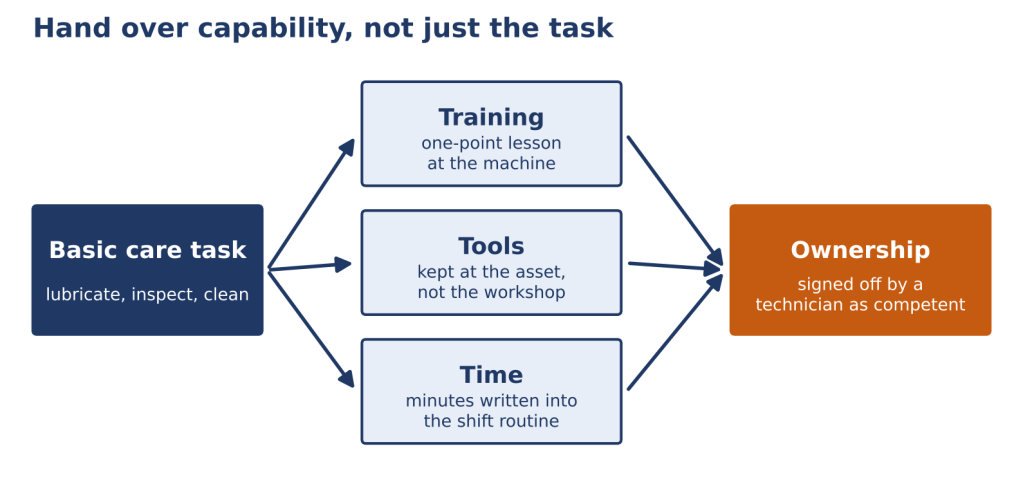
What to do instead: Hand over a task only when three things travel with it: training (a one-point lesson, demonstrated at the machine), tools (kept at the asset, not in the workshop) and time (minutes written into the shift routine). Technicians should sign off each operator as competent, which also gives them a stake in the operator succeeding.
2. Tags That Never Close
What it looks like: The clean-down found 40 defects. Six weeks later, 31 tags are still hanging. Operators stop tagging because “nobody does anything anyway.”
Why it happens: The tagging drive generates work faster than maintenance can plan it, and tags sit outside the normal work order system where nobody owns them.
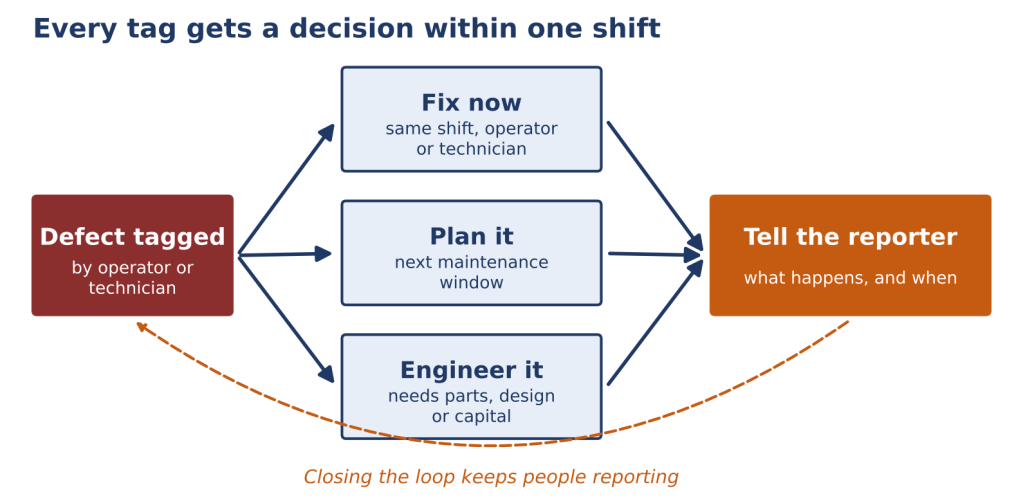
What to do instead: Every tag becomes a work order or a recorded decision within one shift. Sort tags into three groups: fix now (operator or technician, same shift), plan it (next maintenance window) and engineer it (needs parts, design or capital). Review the open tags at the joint handover. If a tag cannot be closed soon, tell the person who raised it why, and when. An honest “not until the October shutdown” keeps trust. Silence kills it.
3. Turning the Scoreboard into a Courtroom
What it looks like: The shared board goes up, and at the first bad week the production manager points at the downtime number and asks maintenance to explain. Next week maintenance comes armed with its own figures on overloads. The board is still shared. The ownership is gone.
Why it happens: Old habits of accountability. Most of us were trained to find who is responsible, not what is responsible.
What to do instead: Agree the ground rules before the board goes up. Numbers start conversations, they do not end them. Every red number gets the systems question from Part One: what in the system allowed this to happen? Leaders set the tone: the first time a number is used as a weapon, the most senior person in the room should stop it, on the spot.
4. Supervisors Who Say One Thing and Do Another
What it looks like: The production supervisor speaks well at the launch, then overrides the first planned maintenance window because the month is behind on tonnes. The maintenance supervisor still sends technicians to fix things without asking the operator what happened.
Why it happens: Supervisors carry the targets. Under pressure, people fall back on the behaviour their own scorecard rewards.
What to do instead: Fix the scorecard as well as the speech. Give production and maintenance supervisors at least one shared target, such as unplanned downtime on the pilot asset. Have them attend each other’s morning meetings. Make it a rule that only the plant manager can cancel a planned window, and record why. Crews watch what their supervisors protect. That is the real policy.
5. Going Site-Wide Before the Pilot Has Proved Anything
What it looks like: The pilot on one pump shows early promise, and management, keen to see results, rolls the programme out across the whole concentrator the next month. Attention, coaching and maintenance capacity are spread across 30 assets. Nothing gets done properly anywhere.
Why it happens: Early wins feel like proof. They are not. A routine has proved itself when it survives a tough month, a staff change, and a production push without anyone driving it.
What to do instead: Set clear exit criteria for the pilot before expanding: for example, three months of joint handovers held every shift, open tags below an agreed number, and a measured fall in repeat failures. Expand one area at a time, and let the pilot crew teach the next crew. Peer teaching travels further than any trainer.
6. Leaving Out the People Who Make the Loop Work
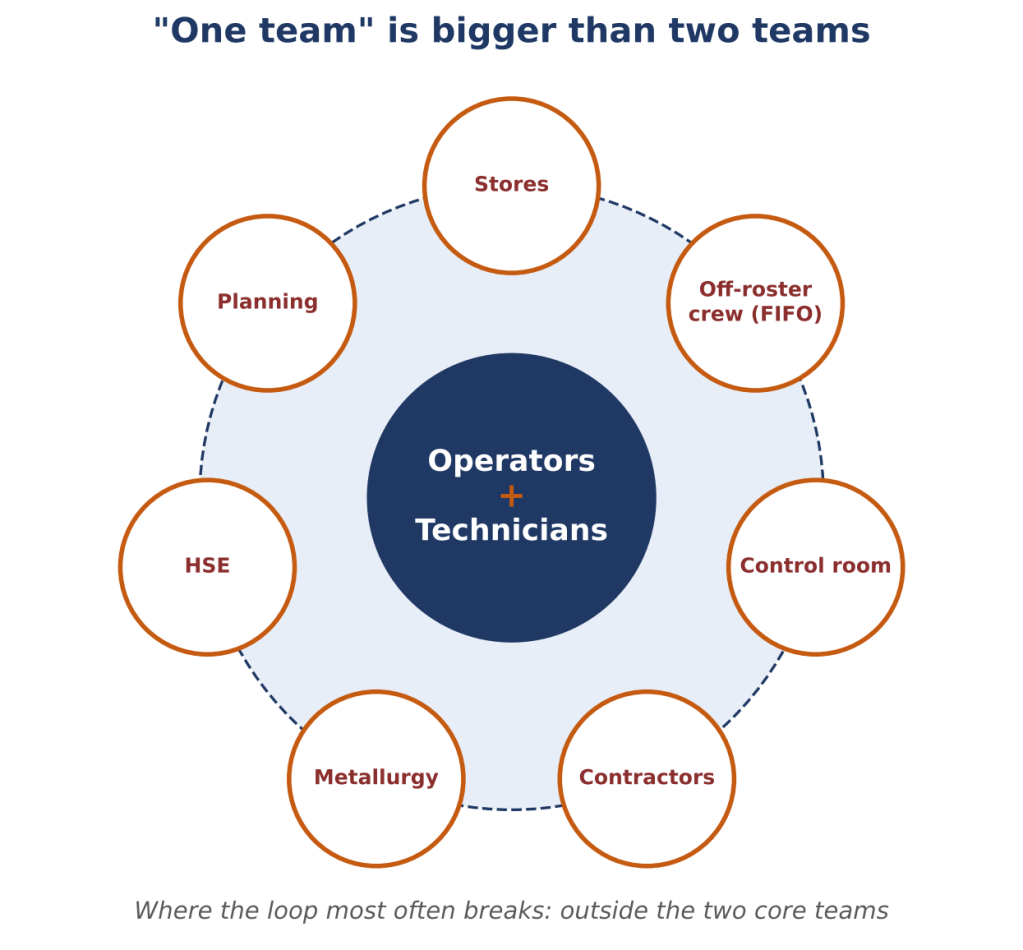
What it looks like: Operators and technicians are fully on board, but the bearing they need is not in stores, the planner never got the work request, and the contractor crew on the next shutdown has never heard of the programme. The loop breaks outside the two teams.
Why it happens: “One team” gets read as “two teams,” production and maintenance. The plant is bigger than that.
What to do instead: Draw the full circuit of support: stores, planning, HSE, metallurgy, contractors, and the control room. Invite them to the joint root cause analysis when their part of the system is involved. Brief contractors on handover and tagging rules before every shutdown. On fly-in, fly-out sites, make the routines part of the rotation handover too, so that ownership does not leave with the crew going off roster.
7. Treating It as a Project with an End Date
What it looks like: A launch, a champion, a six-month plan and a close-out report. The champion moves on, the steering meeting stops, and the routines go with them.
Why it happens: Organisations know how to run projects. They are less practised at changing how ordinary work is done.
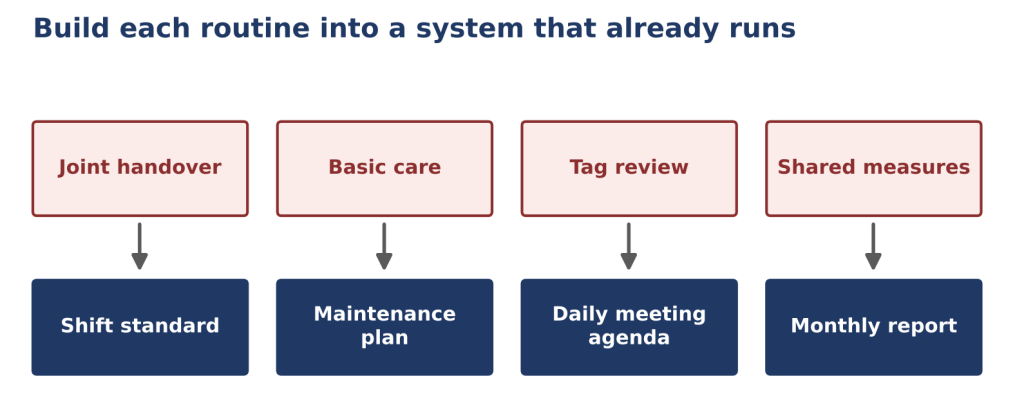
What to do instead: Build the routines into the plant’s existing systems so they outlive any one person: handover format in the shift standard, basic care in the maintenance plan, tag review in the daily meeting agenda, the shared measures in the monthly report. Name an owner per routine, not one champion for everything. The aim is for the programme to disappear into how the plant runs.
A Ten-Minute Trap Check
Traps are easier to spot early than to escape late. Once a month, the production and maintenance supervisors can walk the pilot area together and answer these questions honestly. Any “no” is a trap starting to close.
| Trap | Ask yourselves | Yes / No | |
|---|---|---|---|
| 🧰 | 1. Tasks without capability | Can every operator on the asset show us how to do their basic care, with the tools at hand? | ✅ / ❌ |
| 🏷️ | 2. Tags that never close | Has every tag older than one shift become a work order or a recorded decision, and has the person who raised it been told? | ✅ / ❌ |
| ⚖️ | 3. Scoreboard as courtroom | Did our last review of the board end in actions on the system, not in blame on a team? | ✅ / ❌ |
| 👷 | 4. Supervisors not modelling it | Was every planned maintenance window this month kept, or cancelled only with a recorded reason? | ✅ / ❌ |
| 🚀 | 5. Too big, too fast | Has the pilot met its exit criteria before we added another area? | ✅ / ❌ |
| 🔗 | 6. Missing people | Were stores, planning and contractors involved in the last failure that touched them? | ✅ / ❌ |
| 📅 | 7. Project with an end date | Would every routine still run next month if its owner went on leave tomorrow? | ✅ / ❌ |
Ask the crew the same questions. If their answers differ from the supervisors’, that gap is the most useful finding of the month.
Protect What You Have Built
Every trap in this list starts with a small compromise that seems sensible at the time: a window skipped in a hard week, a tag left for later, a sharp word in a meeting. None of them kills shared ownership on its own. Together, repeated, they teach the plant that the old way is still the real way.
The defence is just as ordinary. Keep promises to the people who report problems. Keep the windows. Keep the board honest and the tone curious. Keep the routines in the plant’s systems, not in one person’s diary.
The first article asked why one plant, one team matters. The second showed how to start. This one is about keeping it alive when the posters fade, and the pressure comes back, because it always does. Run it with care, fix it with understanding, and own it together, especially in the weeks when it would be easier not to.
Written by Ezekiel Nyoni


Leave a Reply